

In 2009, Satomi found herself at a unique hand-weaving studio practicing Saori, a Japanese approach to weaving founded in Osaka, her hometown.

Satomi's practicing Saori in 2009.
What makes Saori especially interesting is that it is not simply a weaving technique. It is a philosophy of making, built around freedom, individuality, and an appreciation for what conventional craft might consider imperfections.

Satomi's Saori work.
The story of Saori began in 1968, when Misao Jo was weaving an obi, a traditional Japanese sash, and accidentally skipped a warp thread. Rather than seeing it as a mistake, she noticed that the irregularity gave the fabric an unexpected character.
That observation led to a much larger idea…
Why should handwoven cloth strive for the regularity and perfection of something made by machine?

Satomi's hand-weaving with soft wax.
A machine can reproduce the same pattern with extraordinary precision. The human hand cannot, and to Jo, that difference was something to celebrate.
In Saori, the weaver responds to the material as they work, allowing irregularities to become traces of the hand and the process that created them.
This way of embracing the traces left by the human hand resonated deeply with Satomi’s own approach to making—something she has often described as ‘perfectly imperfect'.
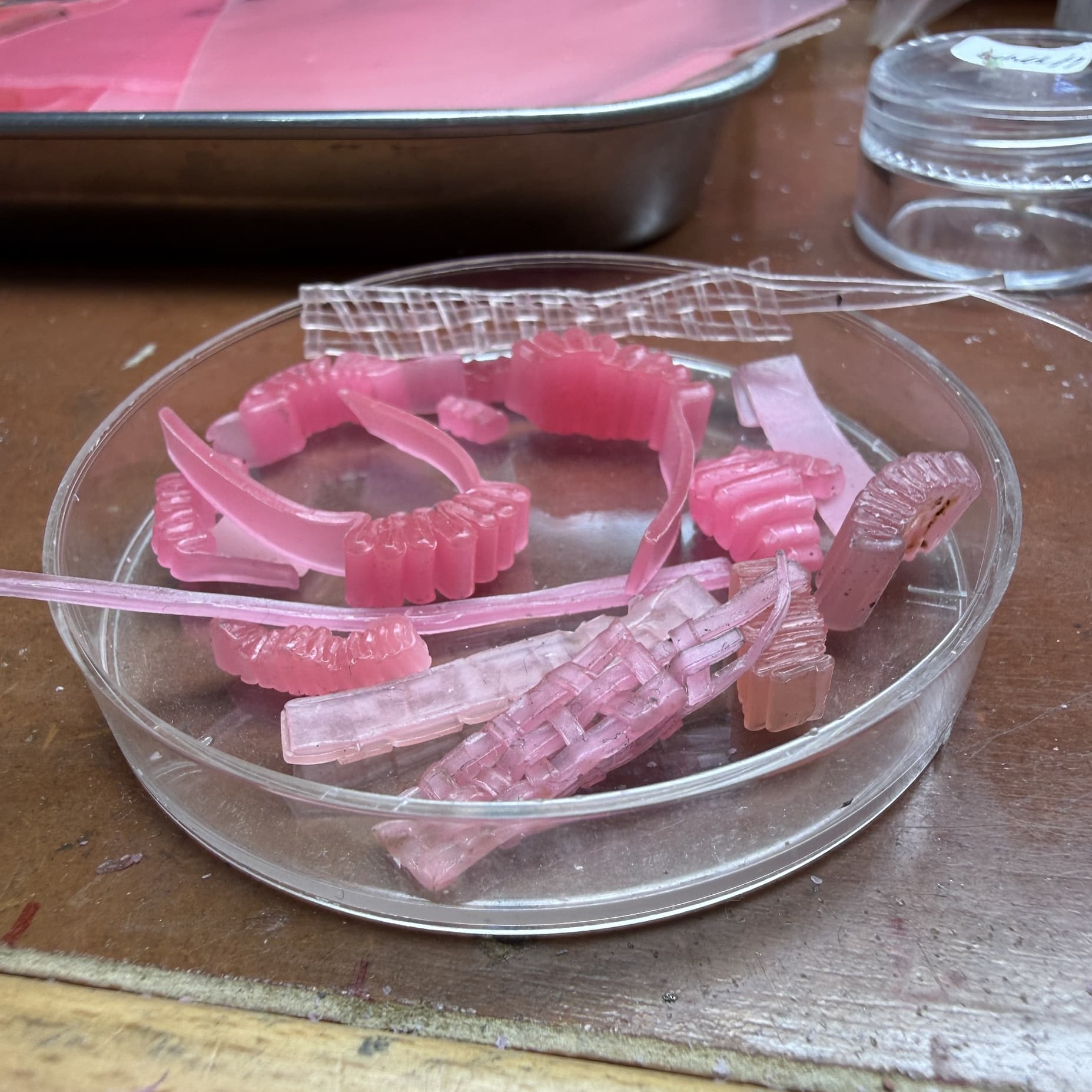
Satomi's exploration with soft wax.
These subtle irregularities have long been an important part of her work. What has continued to evolve is the way she explores new textures and expressions through metal.
For Autumn/Winter 2025, she began shaping wax directly with her hands rather than relying primarily on tools, allowing the act of making itself to become more visible in the resulting forms.
Autumn/Winter 2026 develops this exploration further, introducing new ways of cutting, folding, weaving, and layering sheet wax.